
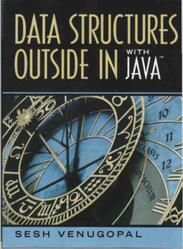
Data Structures Outside In with Java, Venugopal S., 2007.
In this book, we are interested in the interface as well as the implementation of data structures. We follow the outside in approach to presenting them because it will enable students to easily apply in practical software development what they learn in class. Our approach is outlined in the follow ing sequence of steps.
Separation of interface from Implementation.
What an object is capable of doing is its behavior, which is available to its clients via its methods, or interface. (Some data members may also belong to the interface, but such members do not participate in the state of the object. See Section 1.2.5.) Exactly how this behavior is implemented by the object is not known to its clients; that is completely up to the object. Thus the interface of an object is clearly separated from its implementation.
This separation is a cornerstone of object-oriented programming, and is of tremendous advantage to clients. They can ‘‘write to’’ an interface with the guarantee that even if the object changes the way it implements the interface, the clients of the object do not have to write their code because the interface itself is not changed.
ОГЛАВЛЕНИЕ.
Preface.
List of Class Files.
1. Object-Oriented Programming in Java.
1.1. Objects and Encapsulation.
1.2. Classes.
1.3. Inheritance.
1.4. The Object Class.
1.5. Exceptions.
1.6. Input and Output.
1.7. Class Packages.
1.8. Access Control.
1.9. Polymorphism.
1.10. Abstract Classes.
1.11. A Game Park Example.
1.12. Interfaces.
1.13. Generics.
1.14. Summary.
1.15. Exercises.
1.16. Programming Problems.
2. The Big Picture.
2.1. What Are Data Structures?.
2.2. What Data Structures Do We Study?.
2.3. What Are Abstract Data Types?.
2.4. Why OOP and Java for Data Structures?.
2.5. How Do 1 choose the Right Data Structures?.
3. Efficiency of Algorithms.
3.1. Polynomial Arithmetic: A Running Example.
3.2. Basic Operations.
3.3. Input Size.
3.4. Asymptotic Growth of Functions.
3.5. Order and Big Oh.
3.6. Worst-Case and Average.
3.7. Summary.
3.8. Exercises.
4. Unordered List.
4.1 Unordered List Properties.
4.2 Sequential Search.
4.3 A List Class.
4.4 An ExpenseList Class UsingList.
4.5. Linked List.
4.6. A Linked List Class.
4.7. List Class Implementation.
4.8. Summary.
4.9. Exercises.
4.10. Programming Problems.
5. Ordered List.
5.1. Introduction.
5.2. Binary Search.
5.3. Ordering: Interface java.lang.Comparable.
5.4. An OrderedList Class.
5.5. Merging OrderedLists.
5.6. List Consolidation Using OrderedList.
5.7. OrderedList Class Implementation.
5.8. Summary.
5.9. Exercises.
5.10. Programming Problems.
6. Queue.
6.1. Queue Properties.
6.2. UNIX Print Queue.
6.3. A Queue Class.
6.4. A PrintQueue Class Using Queue.
6.5. Queue Class Implementation.
6.6. Summary.
6.7. Exercises.
6.8. Programming Problems.
7. Stack.
7.1. Stack Properties.
7.2. Stack Applications.
7.3. A Stack Class.
7.4. A Postfix Expression Evaluation Package.
7.5. Stack Class Implementation.
7.6. Summary.
7.7. Exercises.
7.8. Programming Problems.
8. Recursion.
8.1. Recursive Definitions.
8.2. Recursive Programs and Backing Out.
8.3. Recursion on an Array: Binary Search.
8.4. Towers of Hanoi: An Application.
8.5. Recursion and Stacks.
8.6. Drawbacks of Recursion.
8.7. Tail Recursion.
8.8. Summary.
8.9. Exercises.
8.10. Programming Problems.
9. Binary Tree and General Tree.
9.1. Binary Tree Properties.
9.2. Binary Tree Traversals.
9.3. A BinaryTree Class.
9.4. Storing and Recreating a BinaryTree.
9.5. Huffman Coding.
9.6. BinaryTree Class Implementation.
9.7. Stack-Based Traversals.
9.8. General Tree.
9.9. Summary.
9.10. Exercises.
9.11. Programming Problems.
10. Binary Search Tree and AVL Tree.
10.1. Comparison Tree.
10.2. Binary Search Tree Properties.
10.3. Binary Search Tree Operations.
10.4. A BinarySearchTree Class.
10.5. Using Class BinarySearchTree.
10.6. BinarySearchTree Class Implementation.
10.7. AVL Tree.
10.8. Binary Search: Average Number of Comparisons.
10.9. Summary.
10.10. Exercises.
10.11. Programming Problems.
11. Heap.
11.1. Heap as Priority Queue.
11.2. Heap Properties.
11.3. Heap Operations.
11.4. A Heap Class.
11.5. Priority Scheduling with Heap.
11.6. Sorting with the Heap Class.
11.7. Heap Class Implementation.
11.8. Updatable Heap.
11.9. Summary.
11.10. Exercises.
11.11. Programming Problems.
12. Hash Table.
12.1. Motivation.
12.2. Hashing.
12.3. Collision Resolution.
12.4. The java.util.HashMapClass.
12.5. Quadratic Probing: Repetition of Probe Locations.
12.6. Summary.
12.7. Exercises.
12.8. Programming Problems.
13. Sorting.
13.1. Insertion Sort.
13.2. Sorting by Divide and Conquer.
13.3. Heapsort.
13.4. Radix Sort.
13.5. Implementation: A Qui cksort Class.
13.6. Heap Build: Linear Running Time.
13.7. Summary.
13.8. Exercises.
13.9. Programming Problems.
14. Graphs 1: Algorithms.
14.1. Modeling Relationships Using Graphs.
14.2. Graph Representation.
14.3. Graph Traversals.
14.4. Topological Sort on a Directed Graph.
14.5. Connected Components of an Undirected Graph.
14.6. Shortest Paths in a Weighted Directed Graph.
14.7. Summary.
14.8. Exercises.
15. Graphs 11: implementation.
15.1. A Directed Graph Class: DirCraph.
15.2. An Undirected Graph Class: UndirCraph.
15.3. A Depth-First Search Class: DFS.
15.4. A Topological Sort Class: DFSTopsort.
15.5. A Connected Components Class: DFSConncomp.
15.6. A Shortest-Paths Class: ShortestPaths.
15.7. Graph Implementation.
15.8. Summary.
15.9. Programming Problems.
Index.
Ниже можно купить эту книгу, если она есть в продаже, и похожие книги по лучшей цене со скидкой с доставкой по всей России.Купить книги
Купить .
По кнопкам выше и ниже «Купить бумажную книгу» и по ссылке «Купить» можно купить эту книгу с доставкой по всей России и похожие книги по самой лучшей цене в бумажном виде на сайтах официальных интернет магазинов Лабиринт, Озон, Буквоед, Читай-город, Литрес, My-shop, Book24, Books.ru.
По кнопке «Купить и скачать электронную книгу» можно купить эту книгу в электронном виде в официальном интернет магазине «Литрес», если она у них есть в наличии, и потом ее скачать на их сайте.
По кнопке «Найти похожие материалы на других сайтах» можно найти похожие материалы на других сайтах.
On the buttons above and below you can buy the book in official online stores Labirint, Ozon and others. Also you can search related and similar materials on other sites.
Дата публикации:
Теги: учебник по программированию :: программирование :: Venugopal
Смотрите также учебники, книги и учебные материалы:

Предыдущие статьи: