
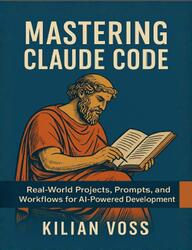
Mastering Claude Code, Voss K., 2025.
This book teaches you how to think, work, and build effectively with Claude Code—not as a novelty, but as a dependable development companion. You will learn how to use Claude to generate, debug, refactor, and optimize code with precision and intent. More importantly, you’ll learn how to direct Claude’s reasoning: how to ask the right questions, frame efficient prompts, and transform vague instructions into reliable, production-ready results.
How Claude Understands Code.
To use Claude Code effectively, it helps to understand how it perceives and reasons about your code. Unlike a human developer who reads with intent and experience, Claude “reads” through a combination of language modeling, pattern recognition, and contextual weighting. Yet the end result often feels remarkably human. It sees relationships between structures, identifies intent behind functions, and reasons about logic flow. This cognitive depth is what allows Claude to suggest meaningful improvements instead of surface-level completions.
At the core of Claude Code’s intelligence lies a transformer-based architecture —the same family of neural models that power most large language systems today. What distinguishes Claude is how Anthropic has tuned this architecture to focus on reasoned interpretation rather than raw prediction. When you provide Claude with a block of code or a technical question, it doesn’t just look at the next likely token; it constructs a temporary representation of the entire context, mapping dependencies between variables, functions, and comments. This internal structure lets it reason about your intent rather than simply filling in blanks.
Contents.
Preface.
Chapter 1 – Getting Started with Claude Code.
1.1 Understanding Claude Code and the Anthropic Ecosystem.
1.2 How Claude Differs from Other AI Coding Tools.
1.3 Installing and Accessing Claude Code.
1.4 Setting Up in VS Code, Cursor, and Zed.
1.5 Your First Prompt: “Hello, Claude!”.
Key Takeaways and Next Steps.
Chapter 2 – Anatomy of an AI Coding Assistant.
2.1 How Claude Understands Code.
2.2 Prompt Engineering Basics for Developers.
2.3 Context, Tokens, and Model Behavior.
2.4 The Request–Response Lifecycle in Claude Code.
2.5 Managing Memory and Conversation State.
2.6 Model Comparison and Capabilities.
Chapter 3 – Prompting Foundations for Developers.
3.1 Writing Effective Prompts for Code Generation.
3.2 Step-by-Step and Chain-of-Thought Techniques.
3.3 Handling Long Contexts and Multi-File Prompts.
3.4 Using System Prompts and Guardrails.
3.5 Troubleshooting Common Prompting Errors.
3.6 The Art of Conversational Precision.
Chapter 4 – Debugging and Code Review with Claude.
4.1 Using Claude to Identify and Fix Bugs.
4.2 Building Automated Code Review Workflows.
4.3 Interpreting and Trusting Claude’s Feedback.
4.4 Testing Debug Fixes in Real Time.
4.5 Lessons from Human-in-the-Loop Debugging.
4.6: Smarter Debugging Through Collaboration.
Chapter 5 – Refactoring and Optimization Workflows.
5.1 Principles of Clean Refactoring.
5.2 Using Claude for Design Pattern Discovery.
5.3 Performance Optimization Through AI Feedback.
5.4 Code Simplification vs. Efficiency Gains.
5.5 Example Project: Optimizing a Web Scraper.
5.6 Best Practices and Cost Considerations.
Chapter 6 – Integrating Claude Code into Your Development Environment.
6.1 Claude Code in VS Code, Zed, and the Terminal.
6.2 Configuring API Keys and Rate Limits.
6.3 Working with Git and Version Control.
6.4 Managing Cost and Token Usage.
6.5 Building a Productive Claude-Driven Workflow.
6.6 Summary Table: Environment Setup Checklist.
Chapter 7 – Project 1: Claude-Powered API Builder.
7.1 Overview and Objectives.
7.2 Setting Up the API Project (Express or FastAPI).
7.3 Generating Boilerplate and Business Logic with Claude.
7.4 Testing Endpoints and Handling Errors.
7.5 Deploying with Claude-Guided CI/CD.
7.6 Lessons Learned and Improvements.
Chapter 8 – Project 2: Claude as Your DevOps Partner.
8.1 Using Claude for Infrastructure Automation.
8.2 Writing Dockerfiles and Deployment Scripts.
8.3 Claude-Assisted CI/CD Pipeline Configuration.
8.4 Integrating with Cloud Providers (AWS, Azure, GCP).
8.5 Example: Automating a Full Deployment Workflow.
Chapter 9 – Project 3: Building a Claude Code Assistant for Teams.
9.1 Multi-Agent and Subagent Workflows.
9.2 Creating Internal Developer Tools with Claude.
9.3 Using Claude for Pair Programming and Code Reviews.
9.4 Example: Sprint Planning Assistant.
9.5 Deploying the Assistant Internally.
9.6 Lessons Learned: Collaboration and Context Sharing.
Chapter 10 – Working with Large Projects and Multi-File Contexts.
10.1 Understanding File Context Management.
10.2 Summarizing and Navigating Large Codebases.
10.3 Incremental Refactoring and Documentation.
10.4 Maintaining Consistency Across Multiple Prompts.
10.5 Example: Refactoring a Legacy Monolith.
Chapter 11 – Security, Risk, and Governance in Claude Workflows.
11.1 Overview of AI Risk Frameworks.
11.2 Preventing Sensitive Data Leakage.
11.3 Reviewing and Validating Claude-Generated Code.
11.4 Security Auditing and Compliance Checks.
11.5 Implementing Access Control for Team Use.
11.6 Best Practices: Responsible AI Coding.
Chapter 12 – Cost Optimization and Performance Efficiency.
12.2 Estimating Token Costs per Task.
12.3 Designing Prompts for Token Efficiency.
12.4 Reducing API Overhead and Latency.
12.5 Monitoring Usage with Metrics and Logs.
12.6 Example: Optimizing an Expensive Build Pipeline.
Chapter 13 – Troubleshooting and Fine-Tuning Claude Code.
13.1 Common Issues and Root Causes.
13.2 Handling Timeouts, Token Limits, and Truncation.
13.3 Clarifying Ambiguous or Incomplete Responses.
13.5 Troubleshooting Table: Problem → Solution.
13.6 Lessons from Iterative Prompt Tuning.
Chapter 14 – The Claude Code Cookbook.
14.1 Overview: Why a Cookbook Matters.
14.2 Frontend Development Prompts.
14.3 Backend and API Prompts.
14.4 Testing and Debugging Prompts.
14.5 Documentation and Reporting Prompts.
14.6 Building Your Own Prompt Recipes.
Chapter 15 – Enterprise and Team Use Cases.
15.1 Claude for Enterprise Development.
15.2 Integrating with CI/CD and GitOps Workflows.
15.3 Using Claude for Quality Assurance and Documentation.
15.4 Governance, Compliance, and Risk Controls.
15.5 Case Study: Continuous Delivery with Claude.
15.6 Enterprise Adoption Playbook.
Chapter 16 – The Future of AI-Assisted Coding.
16.1 The Evolution of Claude and AI Coding Assistants.
16.2 From Human Collaboration to Intelligent Co-Development.
16.3 The Expanding Role of Context and Memory.
16.4 Preparing for Claude 4 and Beyond.
16.5 Staying Updated as the Ecosystem Grows.
Closing Reflections.
Appendices.
A.1 Claude Code Commands & Parameters Quick Reference.
A.2 Token Budget and Cost Planner.
A.3 Troubleshooting Cheat Sheet.
A.4 Best Practices Summary Tables.
A.5 Glossary of Claude and AI Coding Terms.
A.6 Further Reading and Resources.
Acknowledgments.
Request for Reviews and Reader Feedback.
Бесплатно скачать электронную книгу в удобном формате, смотреть и читать:
Скачать книгу Mastering Claude Code, Voss K., 2025 - fileskachat.com, быстрое и бесплатное скачивание.
Скачать файл № 1 - pdf
Скачать файл № 2 - epub
Скачать файл № 3 - mobi
Ниже можно купить эту книгу, если она есть в продаже, и похожие книги по лучшей цене со скидкой с доставкой по всей России.Купить книги
Скачать - epub - Яндекс.Диск.
Скачать - mobi - Яндекс.Диск.
Скачать - pdf - Яндекс.Диск.
Дата публикации:
Теги: учебник по программированию :: программирование :: Voss
Смотрите также учебники, книги и учебные материалы:

Следующие учебники и книги:


Предыдущие статьи: