
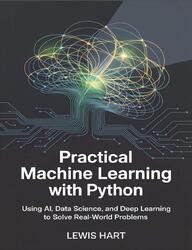
Practical Machine Learning with Python, Hart L., 2025.
The goal of Practical Machine Learning with Python is to make machine learning approachable, understandable, and actionable. It’s not enough to read about algorithms in the abstract; we need to see how they’re applied, tested, deployed, and improved in real-world scenarios. That’s why this book emphasizes hands-on projects, real datasets, and intuitive explanations without skimping on the critical concepts you need to truly understand what's happening under the hood.
Logistic Regression and k-NN.
When your machine learning task involves predicting categories — such as whether an email is spam or not, whether a tumor is malignant or benign, or whether a customer will churn — you’re working in the domain of classification. Unlike regression, where the output is a continuous value, classification predicts discrete classes or labels.
This chapter explores some of the most essential and interpretable algorithms in the classification toolbox: Logistic Regression and k-Nearest Neighbors (k-NN). We’ll understand their inner mechanics, when to use each, and how to implement them practically in Python.
Contents.
Introduction: Welcome to Practical Machine.
Learning.
Why Machine Learning Matters More Than Ever.
Who This Book Is For.
What You’ll Learn and Achieve.
How This Book Is Structured.
Tools You’ll Need: Python, Jupyter, and Key Libraries.
Part I: The Foundations of Machine Learning.
Chapter 1: What Is Machine Learning? Really.
Artificial Intelligence vs. Machine Learning vs. Deep Learning.
The Paradigm Shift: From Rules to Data.
Types of Machine Learning.
Real-World Applications Across Industries.
Chapter 2: Setting Up Your ML Environment.
Installing Python and Essential Libraries.
Using Jupyter Notebook or VS Code.
Creating and Managing Virtual Environments.
Project Folder Structure and First Notebook.
Chapter 3: Data — The Fuel of Machine Learning.
Understanding Features and Labels.
Structured vs. Unstructured Data.
Collecting, Storing, and Cleaning Data.
Handling Missing Data and Data Types.
Chapter 4: Exploratory Data Analysis (EDA).
Descriptive Statistics and Summary Insights.
Visualizing Distributions and Trends.
Detecting Outliers and Correlations.
Using Pandas Profiling and Seaborn.
Part II: Core Machine Learning Algorithms.
Chapter 5: Regression – Predicting Continuous Outcomes.
Linear and Polynomial Regression.
Lasso and Ridge Regularization.
Evaluating Regression Models: MSE, MAE, R².
Project: Predicting House Prices.
Chapter 6: Classification – Predicting Categories.
Logistic Regression and k-NN.
Support Vector Machines (SVM).
Confusion Matrix, Precision, Recall, F1 Score.
Project: Email Spam Classifier.
Chapter 7: Decision Trees and Random Forests.
Tree Building and Splitting Criteria.
Overfitting and Pruning Techniques.
Random Forests and Feature Importance.
Visualizing Trees and Ensemble Voting.
Chapter 8: Clustering and Dimensionality Reduction.
k-Means and Hierarchical Clustering.
Silhouette Scores and Elbow Method.
Principal Component Analysis (PCA).
Project: Customer Segmentation Dashboard.
Part III: Deep Learning Essentials with TensorFlow and Keras.
Chapter 9: Neural Networks for Beginners.
Neurons, Weights, and Layers Explained Simply.
Activation Functions: ReLU, Sigmoid, Softmax.
Forward and Backpropagation Basics.
Visual: Anatomy of a Neural Network.
Chapter 10: Building Deep Learning Models with Keras.
Introduction to TensorFlow and Keras.
Compiling, Training, and Validating Models.
Preventing Overfitting with Dropout and Early Stopping.
Project: Handwritten Digit Recognition (MNIST).
Chapter 11: Convolutional Neural Networks (CNNs).
Understanding Image Data and Channels.
Convolution and Pooling Layers.
Using Pretrained Models (Transfer Learning).
Project: Image Classifier with Custom Dataset.
Chapter 12: Natural Language Processing (NLP).
Text Preprocessing and Tokenization.
Word Embeddings (Word2Vec, GloVe).
Recurrent Neural Networks and LSTM.
Project: Twitter Sentiment Analyzer.
Part IV: Working on Real Projects.
Chapter 13: Building an End-to-End Machine Learning Pipeline.
Data Splitting: Training, Testing, Validation.
Feature Engineering and Selection.
Model Tuning, Cross-Validation, and Persistence.
Flowchart: Complete ML Workflow in Practice.
Chapter 14: Time Series Forecasting.
Components of Time Series Data.
Feature Engineering for Time Series.
ARIMA and LSTM for Forecasting.
Project: Predicting Stock Prices.
Chapter 15: Anomaly Detection.
Understanding Anomalies and Outliers.
Isolation Forests and One-Class SVM.
Applications in Finance, Cybersecurity, and IoT.
Project: Credit Card Fraud Detection.
Part V: Practical Tools, Deployment, and Responsible AI.
Chapter 16: Model Deployment in the Real World.
Creating REST APIs with Flask and FastAPI.
Using Docker to Package Your ML App.
Hosting on Heroku and AWS.
Project: Deploying a Weather Prediction API.
Chapter 17: Model Explainability and AI Ethics.
Black-Box vs. Transparent Models.
SHAP and LIME for Interpretability.
Bias, Fairness, and Accountability in ML.
Table: Bias Types and Mitigation Strategies.
Chapter 18: Staying Relevant in the Field.
Open Datasets and Competitive Platforms (Kaggle, UCI).
Top Python Packages and Tools to Master.
Career Growth Tips and Learning Pathways.
Community, Conferences, and Certifications Appendices.
Appendix A: Python & Pandas Quick Reference Guide.
Core Python Syntax for ML.
Pandas, NumPy, and Matplotlib Cheat Sheet.
Table: Most Common Commands and Their Usage.
Appendix B: Machine Learning Interview Prep.
Key Technical Questions with Sample Answers.
Behavioral and Real-World Scenario Questions.
Table: 20 Must-Know Interview Questions.
Appendix C: ML Project Templates and Best Practices.
Template for Jupyter Notebook ML Projects.
Folder Structure and Checklist.
Downloadable Resources and Reuse Patterns.
Бесплатно скачать электронную книгу в удобном формате, смотреть и читать:
Скачать книгу Practical Machine Learning with Python, Hart L., 2025 - fileskachat.com, быстрое и бесплатное скачивание.
Скачать файл № 1 - pdf
Скачать файл № 2 - epub
Ниже можно купить эту книгу, если она есть в продаже, и похожие книги по лучшей цене со скидкой с доставкой по всей России.Купить книги
Скачать - epub - Яндекс.Диск.
Скачать - pdf - Яндекс.Диск.
Дата публикации:
Теги: учебник по программированию :: программирование :: Hart
Смотрите также учебники, книги и учебные материалы:



Следующие учебники и книги:
Предыдущие статьи: